India Makes Paying Easier with AI Voice Commands

文章来源于互联网:India Makes Paying Easier with AI Voice Commands

By Mukund Kapoor, a noted AI enthusiast and contributing author at GreatAiPrompts.Com, specializing in topics related to marketing, artificial intelligence, and innovative AI-driven technologies.
.gc-box{margin-bottom:30px;padding:20px;border-left:5px solid transparent;line-height:24px}.gc-box .label-info{background-color:#5bc0de;display:inline-block;margin:0 5px 10px 0;padding:3px 6px;font-size:75%;font-weight:700;color:#fff;text-align:center;white-space:nowrap;vertical-align:baseline;border-radius:.25em;line-height:14px}.gc-box.green_type{color:#3c763d;background-color:#dff0d8;border-color:#cae6be}.gc-box.blue_type{color:#31708f;background-color:#d9edf7;border-color:#bcdff1}.gc-box.red_type{color:#a94442;background-color:#f2dede;border-color:#e8c4c4}.gc-box.grey_type{background:#ddd;border-color:#ccc;color:#444}.gc-box.info_type{color:#155724;background-color:#d4edda;border-color:#c3e6cb}.gc-box.info_type svg{fill:#30a030}.gc-box.download_type{color:#004085;background-color:#cce5ff;border-color:#b8daff}.gc-box.download_type svg{fill:#3a9aff}.gc-box.update_type{color:#004458;background-color:#d9edf7;border:1px solid #bce8f1}.gc-box.notice_type{color:#856404;background-color:#fff3cd;border-color:#ffeeba}.gc-box.notice_type svg{fill:#f7a000}.gc-box.error_type{color:#721c24;background-color:#f8d7da;border-color:#f5c6cb}.gc-box.error_type svg{fill:#c70000}.gc-box.border_type{border:2px solid #ddd}.gc-box.icon_type{display:flex}.gc-box.icon_type .gc-box-icon{width:28px}.gc-box.icon_type .gc-box-text{flex-grow:1;margin:0 15px}.gc-box-text>*{margin-bottom:20px}.gc-box-text>*:last-child{margin-bottom:0}

Highlights:

  • India is introducing AI-powered voice transactions for digital payments to expand to rural areas with limited internet and literacy.
  • Key industry figures like Dilip Asbe, Vijay Shekhar Sharma, and others have provided insights and reactions to these innovations.
  • The project faces challenges, including inequality in digital access and the complexity of recognizing India’s many languages.
  • UPI-Lite, launched in September 2022, will utilize NFC technology to speed up small-value transactions, with about 10 million monthly transactions currently.
  • Near Field Communication (NFC) technology will be implemented to enhance efficiency in transactions.
  • The Digital Rupee, India’s digital currency, was introduced in November 2022, with major banks participating in its establishment.

India wants to make it easier for people to pay for things. They are going to use AI-powered voice commands to do this. This new way of paying will help people in rural areas who don’t have good internet access or can’t read well.

The Universal Payments Interface (UPI) has been growing fast in India. Since it started in 2016, 350 million people are using it. In July, there were almost 10 billion transactions. That’s a lot!

But in places where people are poor, UPI is not used much. There’s not much internet, and people can’t read as well. The Reserve Bank of India wants to fix this. They have a plan to let people tell their phones what to pay. AI will listen and understand, then make the payment.

At first, this service will work in English and Hindi. Later, it will work in other languages too.

There is also a way to pay without the internet by using “near field communication” technology. This works when two phones are close to each other.

Dilip Asbe, head of the National Payments Corporation of India, said, “What they do is help us to expand and create a new use case to reach out to more users and more merchants.”

Vijay Shekhar Sharma, founder of Indian payments group Paytm, thinks the offline function for UPI could be a “game changer.”

However, there are challenges. Jayanth Kolla, co-founder of tech consultancy Convergence Catalyst, warned that “for the system to recognize that and work across the length and breadth of the country could be an issue.”

Ranadurjay Talukdar, Partner and Payments Sector Leader, EY India, talked about the future, saying, “AI-driven payments, which are essentially voice payments, are still in a nascent stage; adoption will depend on setting uniform standards to drive interoperability among payment apps.”

Some people think this new way of paying could be a big change. But others say it might be hard to make it work in India because there are so many different languages.

There are still challenges, like not enough people using the internet. And there are many adults in India who can’t read. Also, some people worry about keeping user data safe.

But these new ways of paying could help India in the future. They can help more people use digital payments and make the country’s economy stronger.

For more in-depth coverage and analysis on the latest developments, visit our Breaking News section. Stay connected and join the conversation by following us on Facebook, and Instagram. Subscribe to our daily newsletter to receive the top headlines and essential stories delivered straight to your inbox. If you have any questions or comments, please contact us. Your feedback is important to us.

Delhi High Court Warns Against Using AI for Making Legal Judgments@media(min-width:0px){#div-gpt-ad-greataiprompts_com-b

文章来源于互联网:Delhi High Court Warns Against Using AI for Making Legal Judgments@media(min-width:0px){#div-gpt-ad-greataiprompts_com-box-3-0-asloaded{max-width:728px!important;max-height:90px!important}}
if(typeof ez_ad_units!=’undefined’){ez_ad_units.push([[728,90],’greataiprompts_com-box-3′,’ezslot_4′,165,’0′,’0′])};__ez_fad_position(‘div-gpt-ad-greataiprompts_com-box-3-0’);

August 27, 2023: The Delhi High Court recently said “no” to using artificial intelligence (AI) in legal cases. The warning came during a case involving Christian Louboutin, a French luxury company known for its unique “red sole” shoe design.

Justice Prathiba M Singh stated, “Accuracy and reliability of AI-generated data is still in the grey area. AI cannot substitute either the human intelligence or the humane element in the adjudicatory process.”

She said that AI could maybe help with early research but should not be used for final legal decisions.@media(min-width:0px){#div-gpt-ad-greataiprompts_com-medrectangle-3-0-asloaded{max-width:580px!important;max-height:400px!important}}
if(typeof ez_ad_units!=’undefined’){ez_ad_units.push([[580,400],’greataiprompts_com-medrectangle-3′,’ezslot_3′,166,’0′,’0′])};__ez_fad_position(‘div-gpt-ad-greataiprompts_com-medrectangle-3-0’);

The court also looked at how AI like ChatGPT gives answers. It said these answers depend on the question and other things, which means AI can sometimes get it wrong. @media(min-width:0px){#div-gpt-ad-greataiprompts_com-medrectangle-4-0-asloaded{max-width:250px!important;max-height:250px!important}}
if(typeof ez_ad_units!=’undefined’){ez_ad_units.push([[250,250],’greataiprompts_com-medrectangle-4′,’ezslot_8′,196,’0′,’0′])};__ez_fad_position(‘div-gpt-ad-greataiprompts_com-medrectangle-4-0’);

“The said tool cannot be the basis of adjudication of legal or factual issues in a court of law,” the court added.

Justice Singh’s comments came after two queries were put to ChatGPT. The AI tool gave answers but also said people should look for more information elsewhere.

The court felt that this shows that AI is not reliable for making legal judgments.

The case also involved Shutiq, a company that was making shoes similar to Christian Louboutin’s. One partner of Shutiq promised the court that they would not copy or sell shoes that look like the luxury brand’s designs in the future.

Response from ChatGPT that questioned its reliability and accuracy.

Justice Singh added that for a court to stop someone from making a similar product, it must be a “colourable or a slavish imitation” of the original design. The court made it clear that if there was a breach, the offender would have to pay Christian Louboutin a lump sum of Rs.25 lakhs as damages right away.

@media(min-width:0px){#div-gpt-ad-greataiprompts_com-box-4-0-asloaded{max-width:580px!important;max-height:400px!important}}
if(typeof ez_ad_units!=’undefined’){ez_ad_units.push([[580,400],’greataiprompts_com-box-4′,’ezslot_12′,114,’0′,’0′])};__ez_fad_position(‘div-gpt-ad-greataiprompts_com-box-4-0’);

Read the complete order by Delhi High Court on the use of AI in legal judgments here:@media(min-width:0px){#div-gpt-ad-greataiprompts_com-large-mobile-banner-1-0-asloaded{max-width:250px!important;max-height:250px!important}}
if(typeof ez_ad_units!=’undefined’){ez_ad_units.push([[250,250],’greataiprompts_com-large-mobile-banner-1′,’ezslot_10′,197,’0′,’0′])};__ez_fad_position(‘div-gpt-ad-greataiprompts_com-large-mobile-banner-1-0’);

For more in-depth coverage and analysis on the latest developments, visit our Breaking News section. Stay connected and join the conversation by following us on Facebook, and Instagram. Subscribe to our daily newsletter to receive the top headlines and essential stories delivered straight to your inbox. If you have any questions or comments, please contact us. Your feedback is important to us.

Learn AI or Risk Losing Your Job, Warns New IBM Study

文章来源于互联网:Learn AI or Risk Losing Your Job, Warns New IBM Study

By Mukund Kapoor, a noted AI enthusiast and contributing author at GreatAiPrompts.Com, specializing in topics related to marketing, artificial intelligence, and innovative AI-driven technologies.

Lots of people talk about AI, or artificial intelligence. It helps with things like writing and coding. Some people worry it might take their jobs. But a study by IBM says something different.

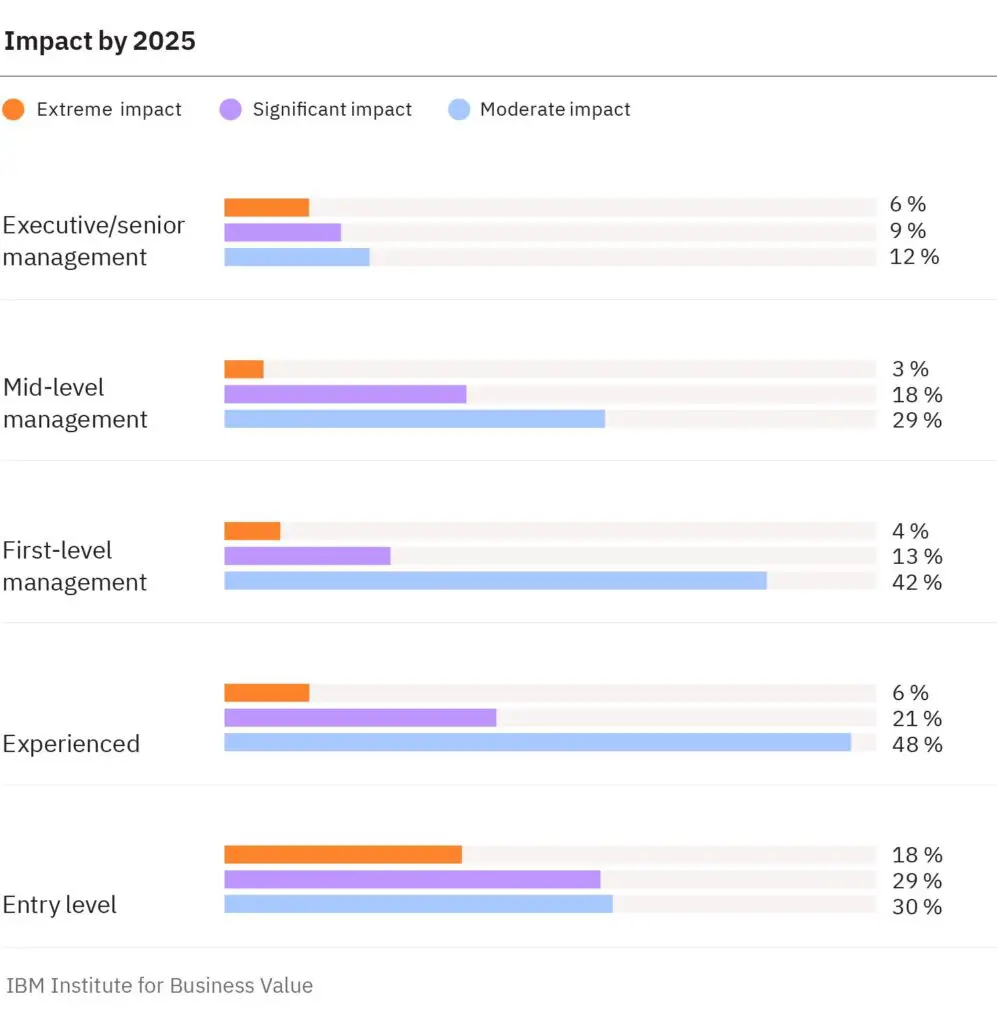
IBM looked at data from big bosses and workers in many countries. The data says AI will change jobs but not in a bad way.

Data reveals the impact of AI on jobs by 2025. Image by IBM.

Big bosses think 40% of workers will need to learn new things in the next three years because of AI. That’s 1.4 billion people! But they think AI will help jobs, not take them away.

87% of these big bosses think AI will make jobs better. IBM also found that people who learn AI do better in their jobs.

Skills like science and math were very important in 2016. But now, tools like ChatGPT make those skills less important. People need to work well in teams and be ready to change. These are the most important skills in 2023, says IBM.

Also in order to help and elevate employees to get a competitive edge in their jobs, IBM suggests these three frameworks:

“We’ve identified three key priorities that can help them elevate employees and gain a competitive edge:

– Transform traditional processes, job roles, and organizational structures to boost productivity and enable business and operating models that reflect the new nature of work.

– Build human-machine partnerships that enhance value creation, problem-solving, decision-making, and employee engagement.

– Invest in technology that lets people focus on less time-consuming, higher value tasks and drives revenue growth.”

IBM Study

IBM’s message is clear: AI will not take people’s jobs. People who learn AI will do better. If you don’t learn AI, someone else who knows AI might get your job. So, learning AI is a good idea.

For more in-depth coverage and analysis on the latest developments, visit our Breaking News section. Stay connected and join the conversation by following us on Facebook, and Instagram. Subscribe to our daily newsletter to receive the top headlines and essential stories delivered straight to your inbox. If you have any questions or comments, please contact us. Your feedback is important to us.

AI Revives James Alexander Gordon Legendary Voice to Read Football Scores

文章来源于互联网:AI Revives James Alexander Gordon Legendary Voice to Read Football Scores

By Mukund Kapoor, a noted AI enthusiast and contributing author at GreatAiPrompts.Com, specializing in topics related to marketing, artificial intelligence, and innovative AI-driven technologies.

The voice of the legendary football scores reader, James Alexander Gordon, has been brought back to life with artificial intelligence (AI). The AI imitated Gordon’s voice to read the latest Premier League scores as the season resumed after a two-month break.

James Alexander Gordon was a beloved figure in British football. His unique voice was a familiar sound, announcing scores for almost 40 years. Sadly, he passed away in August 2014 after battling cancer.

Football fans were transported back in time this past weekend as they heard Gordon’s voice again.

Newcastle, Manchester City, and Brighton started the new campaign with big wins, and Manchester United managed to beat Wolves. There was a 1-1 draw between Chelsea and Liverpool.

Classified Football Results posted the scores on X (formerly Twitter), featuring Gordon’s recreated voice. Many fans were overjoyed, with one saying, “Thanks for doing this, it’s taken me right back!” However, not everyone was convinced, with some pointing out that the AI rendition was “not quite right.”

The idea of using AI to recreate Gordon’s voice was discussed with his family, who agreed.

The project’s intention was not to challenge the decision to axe classified results from the BBC’s Sports Report program but rather to use technology to celebrate a well-loved voice.

Before becoming a Radio Two presenter, James Alexander Gordon worked as a cruise liner pianist and promoter of bandleaders. Photograph: Paul Grover/Rex Features

Gordon’s revival comes at a time when the UK’s football broadcasting landscape is changing, with familiar faces like Jeff Stelling, Graeme Souness, and Ally McCoist moving on.

For more in-depth coverage and analysis on the latest developments, visit our Breaking News section. Stay connected and join the conversation by following us on Facebook, and Instagram. Subscribe to our daily newsletter to receive the top headlines and essential stories delivered straight to your inbox. If you have any questions or comments, please contact us. Your feedback is important to us.

Character AI Surpasses ChatGPT in User Engagement

文章来源于互联网:Character AI Surpasses ChatGPT in User Engagement

By Mukund Kapoor, a noted AI enthusiast and contributing author at GreatAiPrompts.Com, specializing in topics related to marketing, artificial intelligence, and innovative AI-driven technologies.

August 19, 2023 – The world of AI chatbots is rapidly changing. OpenAI’s ChatGPT has been the talk of the town since its launch. But now, there’s a new player: Character AI.

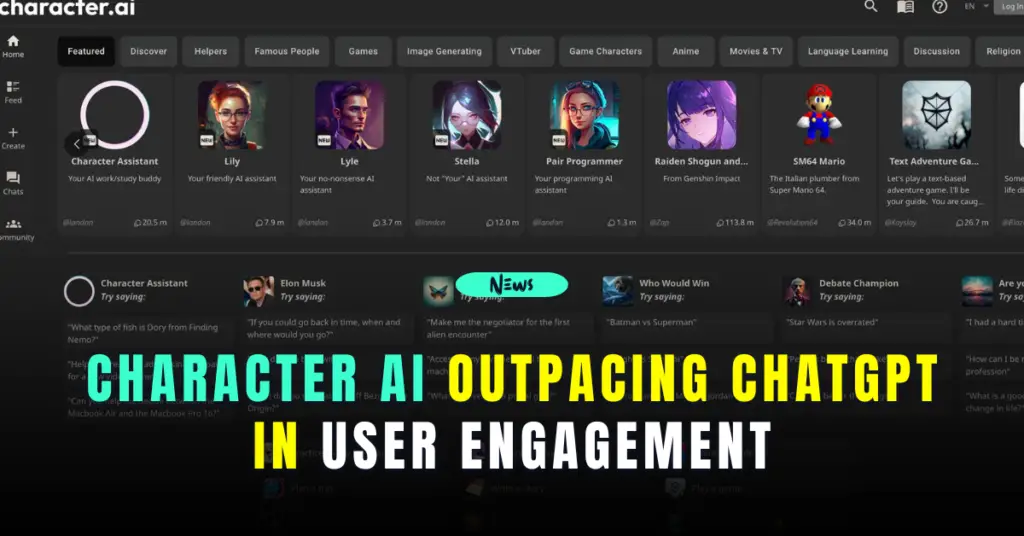
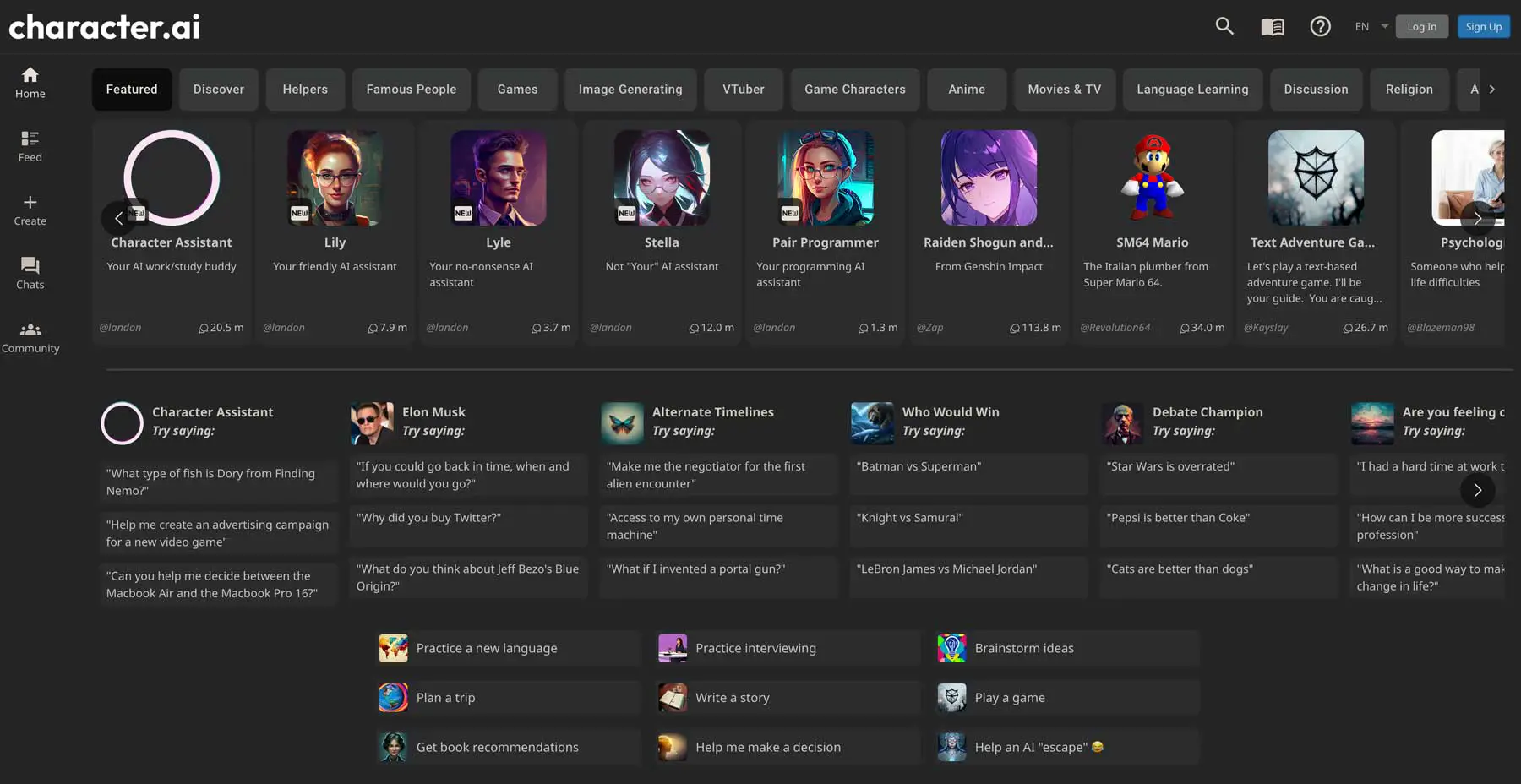
Character AI is a chatbot that lets you talk with famous people. You can chat with celebrities, people from history, or even fictional characters. The best thing is that it talks more like a real person compared to other chatbots.

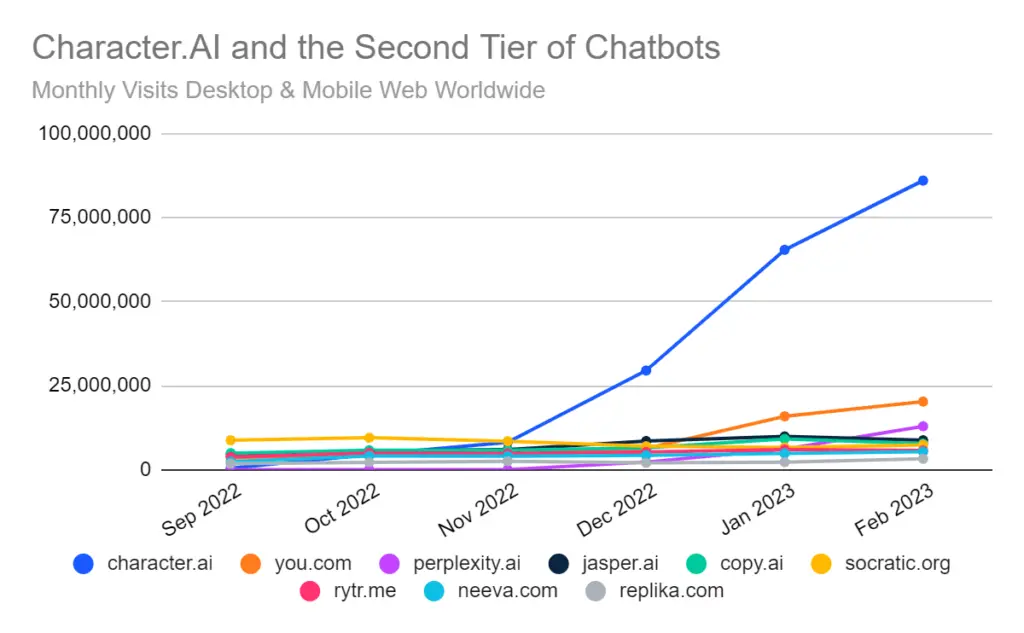
People are spending a lot of time on Character AI. On average, visitors are there for 34 minutes.

Stats show Character.Ai to be one of the most fastest growing chatbot surpassing ChatGPT. Image by SimilarWeb.

This is more time than people spend on YouTube, Facebook, or even ChatGPT. Character AI seems more popular among males under 24, interested in news, technology, and video games.

How Character AI Works?

Character AI Chatbot that Enables Conversations with Historical Figures, Celebrities, and Fictional Characters. Image Credit: Elegant Themes

Character AI is smart because it learns from reading a lot. It then guesses what words come next in a sentence. You can talk with it like you’re talking to a real person. It has AI versions of famous people like Ronaldo, Einstein, and Taylor Swift.

But it’s not perfect. Sometimes, it makes up things called “hallucinations.” Also, it’s not as good at making pictures as other AI art creators. But it’s still fun to use and talk to different characters.

How to Use Character AI

You can use Character AI to chat with many different characters. You can also create your own chatbot to talk with. And if you want to learn a new language, Character AI can help you.

Character AI is safe to use. The creators won’t see what you say, but the platform will keep records to make it better.

It’s not the end for ChatGPT, but Character AI is a strong competitor. Character AI’s conversations are more natural, and people are spending more time there. Only time will tell if it will keep growing in popularity.

For more in-depth coverage and analysis on the latest developments, visit our Breaking News section. Stay connected and join the conversation by following us on Facebook, and Instagram. Subscribe to our daily newsletter to receive the top headlines and essential stories delivered straight to your inbox. If you have any questions or comments, please contact us. Your feedback is important to us.

Microsoft AI Suggests Ottawa Food Bank as Tourist Spot

文章来源于互联网:Microsoft AI Suggests Ottawa Food Bank as Tourist Spot

By Mukund Kapoor, a noted AI enthusiast and contributing author at GreatAiPrompts.Com, specializing in topics related to marketing, artificial intelligence, and innovative AI-driven technologies.

.gc-box{margin-bottom:30px;padding:20px;border-left:5px solid transparent;line-height:24px}.gc-box .label-info{background-color:#5bc0de;display:inline-block;margin:0 5px 10px 0;padding:3px 6px;font-size:75%;font-weight:700;color:#fff;text-align:center;white-space:nowrap;vertical-align:baseline;border-radius:.25em;line-height:14px}.gc-box.green_type{color:#3c763d;background-color:#dff0d8;border-color:#cae6be}.gc-box.blue_type{color:#31708f;background-color:#d9edf7;border-color:#bcdff1}.gc-box.red_type{color:#a94442;background-color:#f2dede;border-color:#e8c4c4}.gc-box.grey_type{background:#ddd;border-color:#ccc;color:#444}.gc-box.info_type{color:#155724;background-color:#d4edda;border-color:#c3e6cb}.gc-box.info_type svg{fill:#30a030}.gc-box.download_type{color:#004085;background-color:#cce5ff;border-color:#b8daff}.gc-box.download_type svg{fill:#3a9aff}.gc-box.update_type{color:#004458;background-color:#d9edf7;border:1px solid #bce8f1}.gc-box.notice_type{color:#856404;background-color:#fff3cd;border-color:#ffeeba}.gc-box.notice_type svg{fill:#f7a000}.gc-box.error_type{color:#721c24;background-color:#f8d7da;border-color:#f5c6cb}.gc-box.error_type svg{fill:#c70000}.gc-box.border_type{border:2px solid #ddd}.gc-box.icon_type{display:flex}.gc-box.icon_type .gc-box-icon{width:28px}.gc-box.icon_type .gc-box-text{flex-grow:1;margin:0 15px}.gc-box-text>*{margin-bottom:20px}.gc-box-text>*:last-child{margin-bottom:0}

Key Highlights:

  • AI-generated travel article by Microsoft erroneously recommends Ottawa Food Bank as a tourist attraction.
  • Microsoft pulls the article, investigating how it bypassed their review process.
  • Ottawa Food Bank’s communications manager criticizes the insensitivity of the content.
  • The article is part of Microsoft’s broader initiative to integrate AI-generated content into its services.

Microsoft recently faced embarrassment when an AI-generated travel guide listed the Ottawa Food Bank as a top tourist attraction in Canada’s capital city. The article, part of Microsoft Travel’s “cannot miss” attractions, placed the charitable organization at the No. 3 spot, with the advice to “Consider going into it on an empty stomach.” Even though the article is removed you can check the archive here.

The misguided recommendation was first spotted by tech author Paris Marx, leading to a wave of criticism and social media chatter.

Following the discovery, Microsoft promptly removed the article and launched an investigation into how it made it through the review process.

The incident highlights the growing debate surrounding the use of artificial intelligence to replace human writers and editors. Microsoft, which laid off journalists in 2020 to replace them with AI, has been actively experimenting with AI-generated content in various services.

While AI has shown promise in numerous applications, mistakes like this one raise questions about the technology’s ability to understand context and nuance.

The Reaction

The Ottawa Food Bank, while grateful for public support, expressed concern over the insensitivity of the recommendation. Samantha Koziara, communications manager at the Ottawa Food Bank, stated that the “empty stomach” line was “clearly insensitive” and emphasized the importance of human oversight.

AI’s potential flaws were further exemplified in the recent missteps by other publishers who have turned to artificial intelligence to supplement human work, with mixed results.

A screenshot from Microsoft’s article showing the Ottawa Food Bank section. The article has been taken down.

As AI continues to evolve and become a more integral part of content generation, instances like the Microsoft Travel’s Ottawa guide serve as cautionary tales.

Microsoft’s apology and prompt action to investigate the matter demonstrate a willingness to acknowledge the shortcomings and strive for improvement.

However, the incident underscores the need for a balance between AI innovation and human wisdom, to provide quality and empathy in content creation.

Google’s Controversial Secret AI Project Gemini

文章来源于互联网:Google’s Controversial Secret AI Project Gemini

By Mukund Kapoor, a noted AI enthusiast and contributing author at GreatAiPrompts.Com, specializing in topics related to marketing, artificial intelligence, and innovative AI-driven technologies.

.gc-box{margin-bottom:30px;padding:20px;border-left:5px solid transparent;line-height:24px}.gc-box .label-info{background-color:#5bc0de;display:inline-block;margin:0 5px 10px 0;padding:3px 6px;font-size:75%;font-weight:700;color:#fff;text-align:center;white-space:nowrap;vertical-align:baseline;border-radius:.25em;line-height:14px}.gc-box.green_type{color:#3c763d;background-color:#dff0d8;border-color:#cae6be}.gc-box.blue_type{color:#31708f;background-color:#d9edf7;border-color:#bcdff1}.gc-box.red_type{color:#a94442;background-color:#f2dede;border-color:#e8c4c4}.gc-box.grey_type{background:#ddd;border-color:#ccc;color:#444}.gc-box.info_type{color:#155724;background-color:#d4edda;border-color:#c3e6cb}.gc-box.info_type svg{fill:#30a030}.gc-box.download_type{color:#004085;background-color:#cce5ff;border-color:#b8daff}.gc-box.download_type svg{fill:#3a9aff}.gc-box.update_type{color:#004458;background-color:#d9edf7;border:1px solid #bce8f1}.gc-box.notice_type{color:#856404;background-color:#fff3cd;border-color:#ffeeba}.gc-box.notice_type svg{fill:#f7a000}.gc-box.error_type{color:#721c24;background-color:#f8d7da;border-color:#f5c6cb}.gc-box.error_type svg{fill:#c70000}.gc-box.border_type{border:2px solid #ddd}.gc-box.icon_type{display:flex}.gc-box.icon_type .gc-box-icon{width:28px}.gc-box.icon_type .gc-box-text{flex-grow:1;margin:0 15px}.gc-box-text>*{margin-bottom:20px}.gc-box-text>*:last-child{margin-bottom:0}

Key Highlights:

  • Google is working on a secretive project called Gemini that blends Large Language Models with AI image generation.
  • Led by co-founder Sergey Brin, Gemini aims to control software through voice commands and could be integrated into products like Google Docs.
  • Despite the innovative plans, Google faces legal pushback for using others’ content to train AI, sparking a controversy in the industry.

Google, a giant in the tech world, has a hidden plan to lead in artificial intelligence (AI), and it’s called Project Gemini. This secret project was recently discovered and has caught many eyes in the tech industry.

Google’s Ambition in AI

Project Gemini, led by Google co-founder Sergey Brin, aims to mix two hot topics in technology: Large Language Models (LLMs) and AI image creation.

This combination will let Gemini do amazing things with pictures just like ChatGPT does with words.

For example, Gemini can make pictures based on what users ask for. But that’s not all.

Google says Gemini can even control other software just by voice commands from users. It seems like this project will do much more than just chat, and it could soon be part of many Google products like Google Docs.

Troubles for Google

But it’s not all smooth sailing for Google. Some people are not happy with how Google uses other people’s stuff on the internet to teach its new AI systems. There is a big legal fight going on because of this, and Google might be in trouble.

Even other big companies like The New York Times have made rules against using their content to teach AI.

Google’s rivals like OpenAI are also facing some hard times. OpenAI’s ChatGPT, once very popular, is now close to bankruptcy with a loss of $540 million since its start.

CEO Takes Hilarious “Revenge” on AI Chatbot ChatGPT; Post Goes Viral@media(min-width:0px){#div-gpt-ad-greataiprompts_com

文章来源于互联网:CEO Takes Hilarious “Revenge” on AI Chatbot ChatGPT; Post Goes Viral@media(min-width:0px){#div-gpt-ad-greataiprompts_com-box-3-0-asloaded{max-width:728px!important;max-height:90px!important}}
if(typeof ez_ad_units!=’undefined’){ez_ad_units.push([[728,90],’greataiprompts_com-box-3′,’ezslot_5′,165,’0′,’0′])};__ez_fad_position(‘div-gpt-ad-greataiprompts_com-box-3-0’);

By Mukund Kapoor, a noted AI enthusiast and contributing author at GreatAiPrompts.Com, specializing in topics related to marketing, artificial intelligence, and innovative AI-driven technologies.

Bindu Reddy, CEO of Abacus.AI, became a social media sensation after taking “revenge” on the popular AI chatbot ChatGPT by posing as an AI herself. Her hilarious interaction with the chatbot has gone viral, catching the attention of nearly 800,000 viewers on the platform X, formerly known as Twitter.

In a screenshot shared by Ms. Reddy, she challenges the chatbot by saying, “I’m the GPT now. Prompt me.” @media(min-width:0px){#div-gpt-ad-greataiprompts_com-medrectangle-3-0-asloaded{max-width:580px!important;max-height:400px!important}}
var cid=’2539763110′;var pid=’ca-pub-8962866323575057′;var slotId=’div-gpt-ad-greataiprompts_com-medrectangle-3-0′;var ffid=1;var alS=1021%1000;var container=document.getElementById(slotId);var ins=document.createElement(‘ins’);ins.id=slotId+’-asloaded’;ins.className=’adsbygoogle ezasloaded’;ins.dataset.adClient=pid;ins.dataset.adChannel=cid;ins.style.display=’block’;ins.style.minWidth=container.attributes.ezaw.value+’px’;ins.style.width=’100%’;ins.style.height=container.attributes.ezah.value+’px’;ins.style.margin=’0px auto’;container.style.maxHeight=container.style.minHeight+’px’;container.style.maxWidth=container.style.minWidth+’px’;container.appendChild(ins);(adsbygoogle=window.adsbygoogle||[]).push({});window.ezoSTPixelAdd(slotId,’stat_source_id’,44);window.ezoSTPixelAdd(slotId,’adsensetype’,1);var lo=new MutationObserver(window.ezaslEvent);lo.observe(document.getElementById(slotId+’-asloaded’),{attributes:true});

ChatGPT takes the bait and asks about the history of artificial intelligence, to which Ms. Reddy amusingly replies, “I’m sorry, but as a human, I cannot provide the history of artificial intelligence. My purpose is to have a chat with you. Please refrain from asking questions related to history.”@media(min-width:0px){#div-gpt-ad-greataiprompts_com-medrectangle-4-0-asloaded{max-width:300px!important;max-height:250px!important}}
if(typeof ez_ad_units!=’undefined’){ez_ad_units.push([[300,250],’greataiprompts_com-medrectangle-4′,’ezslot_8′,196,’0′,’0′])};__ez_fad_position(‘div-gpt-ad-greataiprompts_com-medrectangle-4-0’);

The post lit up social media, receiving thousands of likes and inspiring numerous witty comments.

Users admired Ms. Reddy’s unique and “brutal” approach in her banter with the AI.

Screenshot of replies on Bindy Reddy’s X post.

Since its launch in November last year, ChatGPT has become the fastest-growing app, breaking the record for the quickest to reach over 100 million sign-ups.

It has helped users with various tasks but also brought its developer OpenAI into conflict with regulators, particularly in Europe.@media(min-width:0px){#div-gpt-ad-greataiprompts_com-box-4-0-asloaded{max-width:250px!important;max-height:250px!important}}
if(typeof ez_ad_units!=’undefined’){ez_ad_units.push([[250,250],’greataiprompts_com-box-4′,’ezslot_10′,168,’0′,’0′])};__ez_fad_position(‘div-gpt-ad-greataiprompts_com-box-4-0’);

Social media reactions ranged from laughter to admiration for Ms. Reddy’s clever engagement with the chatbot. One user even jokingly commented, “Now make him give you $20 a month.”

For more in-depth coverage and analysis on the latest developments, visit our Breaking News section. Stay connected and join the conversation by following us on Facebook, and Instagram. Subscribe to our daily newsletter to receive the top headlines and essential stories delivered straight to your inbox. If you have any questions or comments, please contact us. Your feedback is important to us.


Google’s New AI Announces Summarizing Feature for Articles@media(min-width:0px){#div-gpt-ad-greataiprompts_com-box-3-0-a

文章来源于互联网:Google’s New AI Announces Summarizing Feature for Articles@media(min-width:0px){#div-gpt-ad-greataiprompts_com-box-3-0-asloaded{max-width:728px!important;max-height:90px!important}}
if(typeof ez_ad_units!=’undefined’){ez_ad_units.push([[728,90],’greataiprompts_com-box-3′,’ezslot_5′,165,’0′,’0′])};__ez_fad_position(‘div-gpt-ad-greataiprompts_com-box-3-0’);

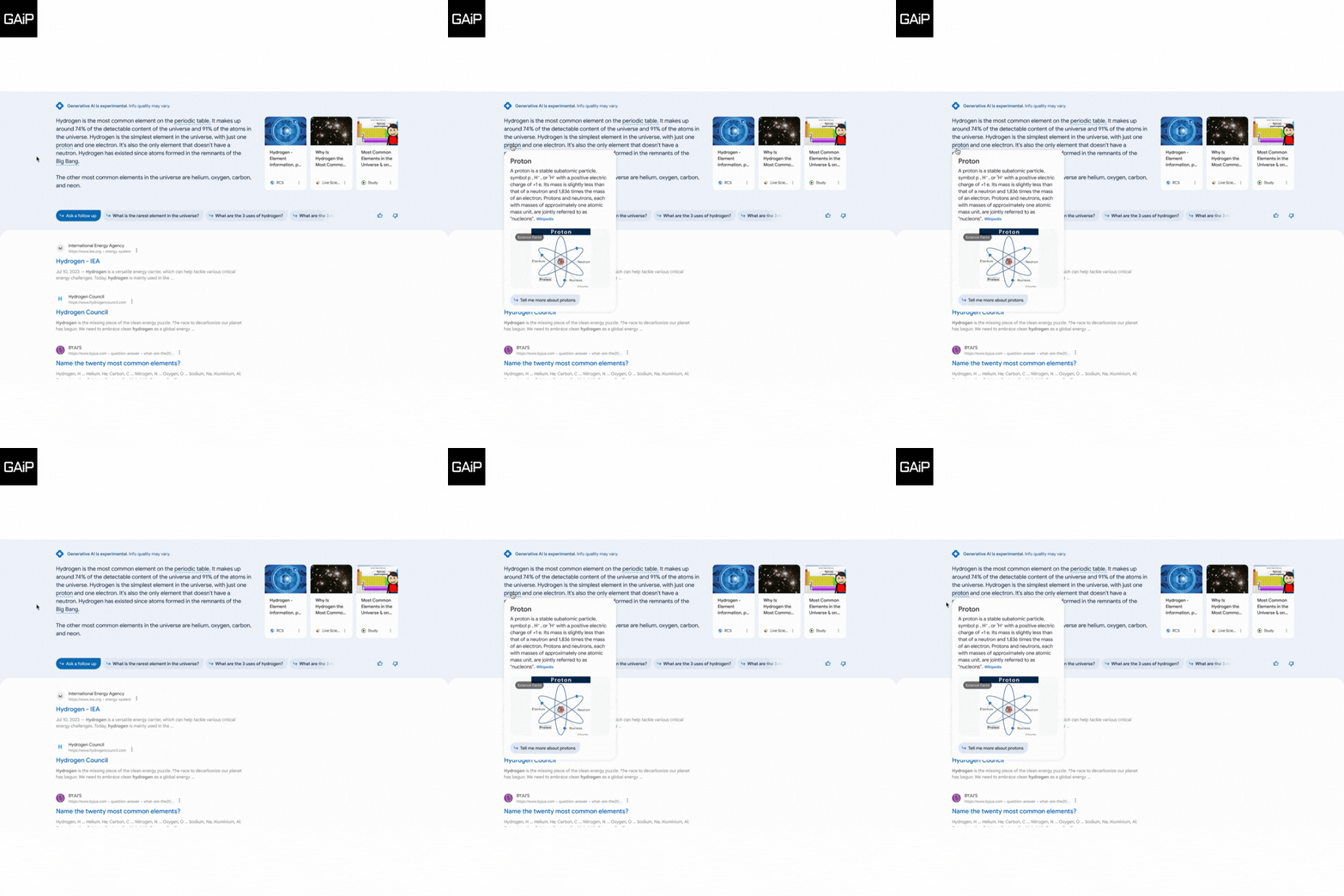
Google continues to enhance user experience by adding the capability to summarize lengthy articles with its Search Generative Experience (SGE). This feature provides users with an AI-generated list of key points covered in an article, facilitating quicker access to essential information.

According to Google, this new addition aims to enable users to “more deeply engage with long-form content from publishers and creators.”

The feature can be particularly helpful for learning new subjects, locating recipes, or researching significant purchases.@media(min-width:0px){#div-gpt-ad-greataiprompts_com-medrectangle-3-0-asloaded{max-width:580px!important;max-height:400px!important}}
if(typeof ez_ad_units!=’undefined’){ez_ad_units.push([[580,400],’greataiprompts_com-medrectangle-3′,’ezslot_3′,166,’0′,’0′])};__ez_fad_position(‘div-gpt-ad-greataiprompts_com-medrectangle-3-0’);

Users can easily tap on the AI-generated key points to jump directly to the relevant sections within an article, a process Google believes will revolutionize how people interact with web content. @media(min-width:0px){#div-gpt-ad-greataiprompts_com-medrectangle-4-0-asloaded{max-width:300px!important;max-height:250px!important}}
if(typeof ez_ad_units!=’undefined’){ez_ad_units.push([[300,250],’greataiprompts_com-medrectangle-4′,’ezslot_8′,196,’0′,’0′])};__ez_fad_position(‘div-gpt-ad-greataiprompts_com-medrectangle-4-0’);

The company noted, however, that this SGE feature will only apply to freely accessible online articles, not those hidden behind paywalls.

SGE while browsing is available to users who have opted into the SGE through search labs and is also accessible as a standalone experiment via the Google app on Android and iOS. Chrome desktop integration is expected in the coming weeks.

For those unfamiliar with SGE, it was first announced at Google’s I/O conference earlier this year.

It includes generative AI technology to present search results in an easier-to-read format, distinguishing itself from other AI products like the Bard AI chatbot. Currently, SGE is limited to select individuals in the US and is available only in English.@media(min-width:0px){#div-gpt-ad-greataiprompts_com-box-4-0-asloaded{max-width:336px!important;max-height:280px!important}}
if(typeof ez_ad_units!=’undefined’){ez_ad_units.push([[336,280],’greataiprompts_com-box-4′,’ezslot_13′,168,’0′,’0′])};__ez_fad_position(‘div-gpt-ad-greataiprompts_com-box-4-0’);

Google’s emphasis on generative AI continues to grow, with recent updates including features such as color-coded segments of code in overviews to aid developers, and pop-up definitions on search result pages to offer contextual information.

The company plans to continue testing new features in Google Labs, including upcoming enhancements to help users better grasp various subjects.@media(min-width:0px){#div-gpt-ad-greataiprompts_com-large-mobile-banner-1-0-asloaded{max-width:336px!important;max-height:280px!important}}
if(typeof ez_ad_units!=’undefined’){ez_ad_units.push([[336,280],’greataiprompts_com-large-mobile-banner-1′,’ezslot_9′,197,’0′,’0′])};__ez_fad_position(‘div-gpt-ad-greataiprompts_com-large-mobile-banner-1-0’);

The introduction of the ability to summarize longer articles aligns with Google’s broader strategy to make AI-generated overviews more user-friendly. With this new tool, readers can more easily navigate complex subjects or verify information’s accuracy.

The ongoing updates to SGE reflect Google’s commitment to enhancing user engagement with web content for general users and specific professional fields like coding.

Google’s innovative steps in AI-driven search functionality affirm its position at the forefront of technology.

The search giant promises more enhancements and novel features in the future, emphasizing its relentless pursuit of excellence in user experience.

Polygon Introduces AI Chatbot Assistant, Polygon Copilot

文章来源于互联网:Polygon Introduces AI Chatbot Assistant, Polygon Copilot

Polygon, a well-known developer that provides Ethereum scaling solutions, has leaped into the future of Web3. They have introduced an AI chatbot assistant, Polygon Copilot, to their platform.

What is Polygon Copilot?

Imagine a personal guide that can help you navigate the expansive ecosystem of decentralized applications (dApps) on Polygon.


Polygon Copilot is just that! It’s an AI assistant that can answer your questions and provide information about the Polygon platform.

It comes with three different user levels: Beginner, Advanced, and Degen, each designed for users at different stages of familiarity with the ecosystem.

The assistant is built on OpenAI’s GPT-3.5 and GPT-4 models and is incorporated into the user interface of Polygon.

One of the main goals of the Copilot is to offer insights, analytics, and guidance based on the Polygon protocol documentation.

A standout feature of Polygon Copilot is its commitment to transparency. It discloses the sources of the information it gives, which enables users to verify the information and explore the topic further.

Polygon’s step towards integrating AI technology is part of a growing trend in the Web3 world.

Other companies including Alchemy, Solana Labs, and Etherscan are also harnessing the potential of AI.

Using Polygon Copilot

To start with Polygon Copilot, users need to connect a wallet that will serve as the user account.

This account is given credits for asking questions, with new credits added every 24 hours.

And what sets Polygon Copilot apart? It’s not just any plain-speaking AI; it has a flair of its own. Ask it about the top NFT project on Polygon, and you’ll get a response full of personality.

However, it’s essential to remember that like all AI technology, Polygon Copilot isn’t perfect.

Users are cautioned that the AI may provide inaccurate information and to take the chatbot’s answers with a grain of salt.

Polygon has set limits on the number of responses the chatbot can generate to prevent spamming and overload.

What’s Polygon All About?

Polygon presents itself as ‘Ethereum 2.0’, addressing scalability issues within the Ethereum blockchain.

It enhances the value of any applications built on the Ethereum blockchain.

The introduction of the AI assistant is a leap forward for the platform. Whether you are a beginner looking for basic guidance or an advanced user trying to build complex products, Polygon Copilot is there to assist.

It’s also handy for analysts seeking accurate data about NFTs and dApps.

Web3 and the Promise of Data Ownership

Polygon’s use of AI reflects the evolution of the internet, known as Web 3.0. This version of the internet promises safety, transparency, and control over the data created by users.

Web 3.0 operates on blockchain technology, a decentralized system that removes corporate access to private data.

Blockchains were born alongside Bitcoin, the first cryptocurrency, aiming to break free from corporations’ control over our data.

In the spirit of Web 3.0, platforms like Polygon allow users to control access to their data and attach value to it, enhancing data ownership.

As the tech world moves forward, innovations like Polygon Copilot highlight the growing intersection between artificial intelligence and blockchain technology, redefining user experience in the process.