Meta, a leading name in the tech industry, has made a significant leap in artificial intelligence (AI) by developing Voicebox, an advanced tool capable of generating lifelike speech.
Despite the tool’s potential, the company has chosen not to release it immediately due to concerns about potential misuse.
Voicebox
Announced last Friday, Voicebox can create convincing voice dialogue, opening up a range of possibilities, from enhancing communication across languages to delivering lifelike character dialogue in video games.
Unique in its functionality, Voicebox can generate speech it wasn’t specifically trained for.
All it requires is some text input and a small audio clip, which it then uses to create a whole new speech in the voice of the source audio.
Introducing Voicebox, a new breakthrough generative speech system based on Flow Matching, a new method proposed by Meta AI. It can synthesize speech across six languages, perform noise removal, edit content, transfer audio style & more.
In a breakthrough from traditional AI speech tools, Voicebox learns directly from raw audio and its corresponding transcription, eliminating the need for task-specific training with carefully curated datasets.
Like other generative AI work, Voicebox is able to create high-quality outputs from scratch or modify samples, but instead of images/video, it produces high-quality audio.
Unlike autoregressive models, it can modify any part of a given sample — not just the end of a clip.
Moreover, this impressive tool can produce audio in six languages – English, French, German, Spanish, Polish, and Portuguese – offering a realistic representation of natural human speech.
Potential Misuse and Meta’s Precautionary Approach
While Voicebox opens up exciting possibilities, Meta is fully aware of the potential misuse of such a tool.
The AI tool could be misused to create ‘deepfake’ dialogues, replicating the voices of public figures or celebrities in an unethical manner.
To counter this risk, Meta has developed AI classifiers, akin to spam filters, that can differentiate between human speech and speech generated by ‘Voicebox’.
The company is advocating for transparency in AI development, coupled with a firm commitment to responsible use. As part of this commitment, Meta has no current plans to make ‘Voicebox’ publicly available, emphasizing the need to balance openness with responsibility.
Instead of launching a functional tool, Meta is offering audio samples and a research paper to help researchers understand its potential and work towards responsible use.
Global Concerns Over AI Misuse
The rapid advancements in AI are causing concern among global leaders, including the United Nations (UN).
Creating AI tools like ‘Voicebox’ offers numerous possibilities but underscores the importance of cautious development and responsible use to prevent misuse.
As we continue to stride forward in the field of AI, these concerns will remain paramount.
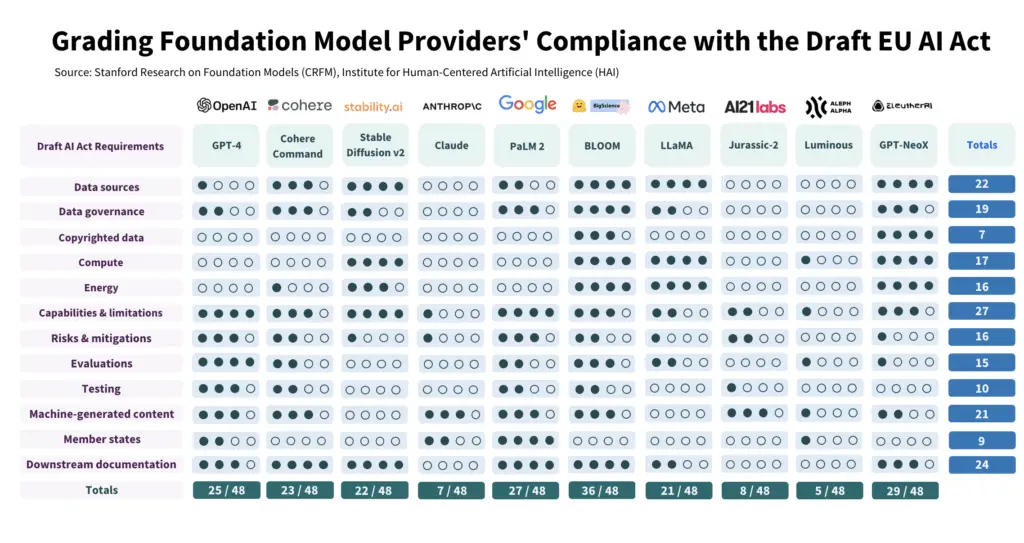
A recent study conducted by researchers from Stanford University concludes that current large language models (LLMs) such as OpenAI’s GPT-4 and Google’s Bard are failing to meet the compliance standards set by the European Union (EU) Artificial Intelligence (AI) Act.
Understanding the EU AI Act
The EU AI Act, the first of its kind to regulate AI on a national and regional scale, was recently adopted by the European Parliament.
It not only oversees AI within the EU, a region housing 450 million people but also sets the precedent for AI regulations globally.
However, as per the Stanford study, AI companies have a considerable distance to cover to attain compliance.
Compliance Analysis of AI Providers
In their study, the researchers evaluated ten major model providers against the 12 requirements of the AI Act, scoring each provider on a 0 to 4 scale.
Stanford’s report says:
“We present the final scores in the above figure with the justification for every grade made available. Our results demonstrate a striking range in compliance across model providers: some providers score less than 25% (AI21 Labs, Aleph Alpha, Anthropic) and only one provider scores at least 75% (Hugging Face/BigScience) at present. Even for the highest-scoring providers, there is still significant margin for improvement. This confirms that the Act (if enacted, obeyed, and enforced) would yield significant change to the ecosystem, making substantial progress towards more transparency and accountability.”
The findings displayed a significant variation in compliance levels, with some providers scoring below 25%, and only Hugging Face/BigScience scoring above 75%.
This suggests a considerable scope for improvement even for high-scoring providers.
The Problem Areas
Do Foundation Model Providers Comply with the Draft EU AI Act? Problem Areas
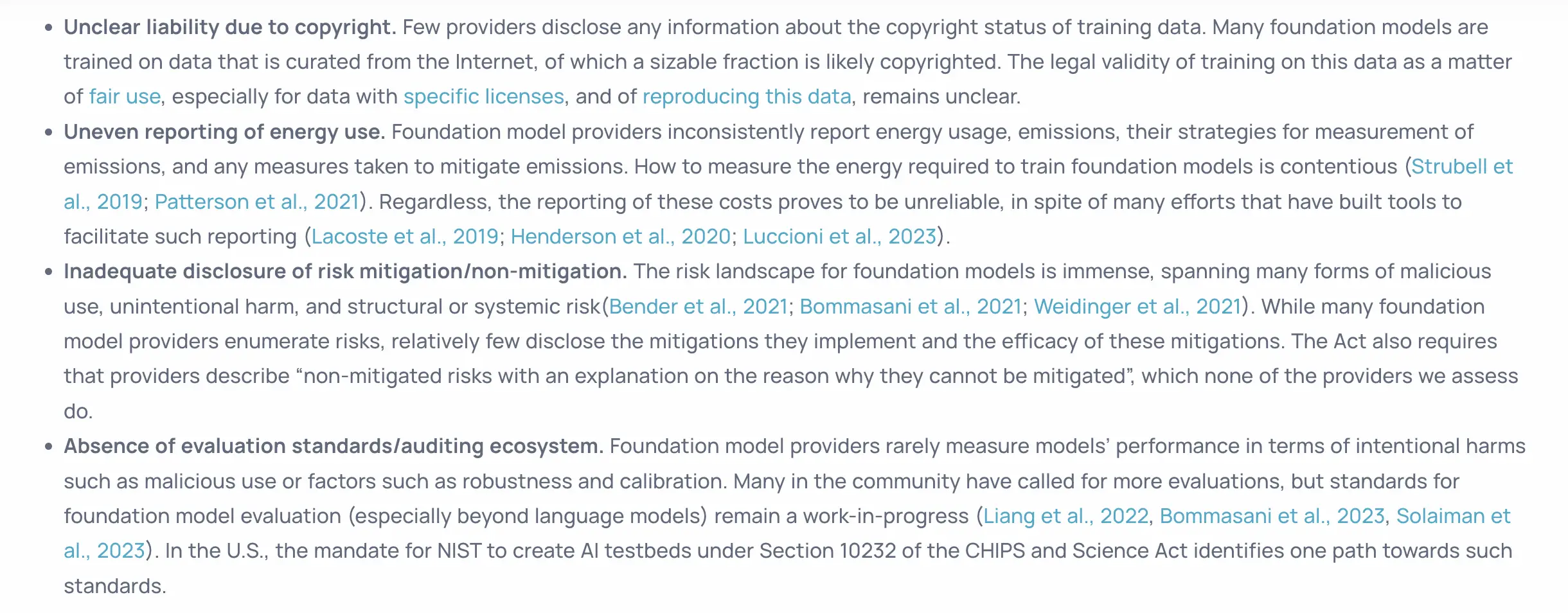
The researchers highlighted key areas of non-compliance, including a lack of transparency in disclosing the status of copyrighted training data, energy consumption, emissions, and risk mitigation methodology.
They also observed a clear difference between open and closed model releases, with open releases providing better disclosure of resources but posing bigger challenges in controlling deployment.
The study concludes that all providers, regardless of their release strategy, have room for improvements.
A Reduction in Transparency
In recent times, major model releases have seen a decline in transparency.
OpenAI, for instance, chose not to disclose any data and compute details in their reports for GPT-4, citing competitive landscape and safety implications.
Potential Impact of the EU AI Regulations
The Stanford researchers believe that the enforcement of the EU AI Act could significantly influence the AI industry.
The Act emphasises the need for transparency and accountability, encouraging large foundation model providers to adapt to new standards.
However, the swift adaptation and evolution of business practices to meet regulatory requirements remain a major challenge for AI providers.
Despite this, the researchers suggest that with robust regulatory pressure, providers could achieve higher compliance scores through meaningful yet feasible changes.
The Future of AI Regulation
The study offers an insightful perspective on the future of AI regulation.
The researchers assert that if properly enforced, the AI Act could substantially impact the AI ecosystem, promoting transparency and accountability.
As we stand on the threshold of regulating this transformative technology, the study emphasises the importance of transparency as a fundamental requirement for responsible AI deployment.
AI chatbot, ChatGPT, a creation of OpenAI, is under scrutiny due to its frequent inability to distinguish fact from fiction, leaving users often led astray by the information it provides.
The Warning Sign Often Ignored
OpenAI has highlighted on its homepage one of the many limitations of ChatGPT – it may sometimes provide incorrect information.
Although this warning holds true for several information sources, it brings to light a concerning trend. Users often disregard this caveat, assuming the data provided by ChatGPT to be factual.
Unreliable Legal Aid, The Case of Steven A. Schwartz
The misleading nature of ChatGPT came into stark focus when US lawyer Steven A.
Over the past few months, there have been several reports of people being misled by its fallacies, which have been largely inconsequential but nonetheless worrying.
ChatGPT confirmed, incorrectly, that they were, leading to the threat of failing the entire class. This incident underscores the risk of the misinformation that ChatGPT can spread, potentially leading to more serious consequences.
Cases like these do not entirely discredit the potential of ChatGPT and other AI chatbots. In fact, these tools, under the right conditions and with adequate safeguards, could be exceptionally useful.
However, it’s crucial to realize that at present, their capabilities are not entirely reliable.
The Role of the Media and OpenAI
The media and OpenAI bear some responsibility for this issue.
Media often portrays these systems as emotionally intelligent entities, failing to emphasize their unreliability. Similarly, OpenAI could do more to warn users of the potential misinformation that ChatGPT can provide.
Recognizing ChatGPT as a Search Engine
The tendency of users to utilize ChatGPT as a search engine should be acknowledged by OpenAI, leading them to provide clear and upfront warnings.
Chatbots present information in a regenerated text format and a friendly, all-knowing tone, making it easy for users to assume the information is accurate.
This pattern reinforces the need for stronger disclaimers and cautionary measures from OpenAI.
The Path Forward
OpenAI needs to implement changes to reduce the likelihood of users being misled.
This could include programming ChatGPT to caution users to verify its sources when asked for factual citations, or making it clear when it is incapable of making a judgment.
OpenAI has indeed made improvements, making ChatGPT more transparent about its limitations.
However, inconsistencies persist and call for more action to ensure that users are fully aware of the potential for error and misinformation.
Without such measures, a simple disclaimer like “May occasionally generate incorrect information” seems significantly inadequate.
Researchers have found a new method to determine whether a piece of text was penned by a human or an artificial intelligence (AI).
This new detection technique leverages a model named RoBERTa, which helps to analyze the structure of text.
Finding the Differences
The study revealed that the text produced by AI systems, such as ChatGPT and Davinci, displays different patterns compared to human text.
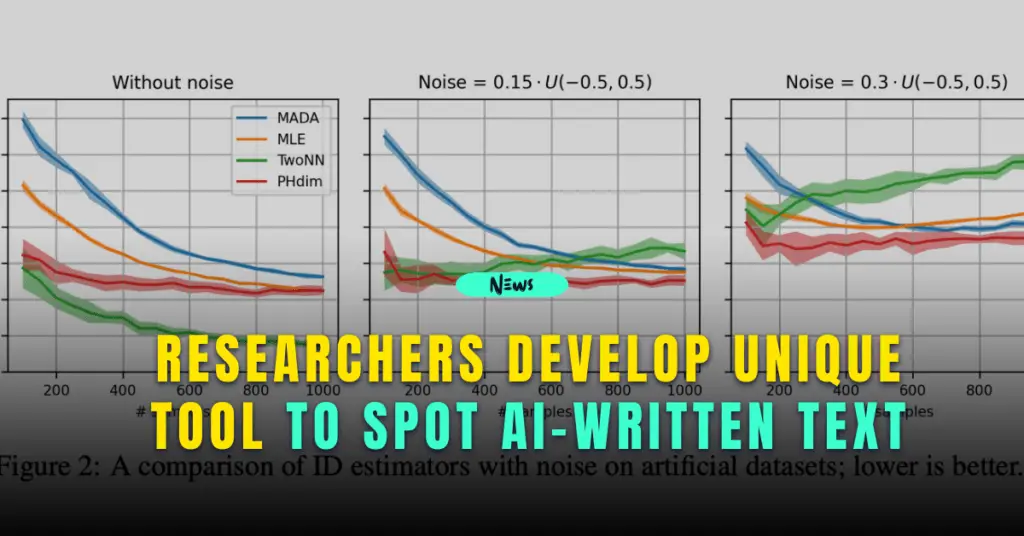
When these texts were visualized as points in a multi-dimensional space, it was found that the points representing AI-written text occupied a lesser area than the points representing human-written text.
Using this key difference, researchers designed a tool that can resist common tactics employed to camouflage AI-written text.
The performance of this tool remained impressive even when it was tested with various types of text and AI models, showing high accuracy.
However, its accuracy decreased when the tool was tested with a sophisticated hiding method called DIPPER.
Despite this, it still performed better than other available detectors.
One of the exciting aspects of this tool is its capability to work with languages other than English. The research showed that while the pattern of text points varied across languages, AI-written text consistently occupied a lesser space than human-written text in every specific language.
Looking Ahead
While the researchers acknowledged that the tool faces difficulties when dealing with certain types of AI-generated text, they remain optimistic about potential enhancements in the future.
They also suggested exploring other models, similar to RoBERTa, for understanding the structure of text.
Earlier this year, OpenAI introduced a tool designed to distinguish between human and AI-generated text.
Although this tool provides valuable assistance, it is not flawless and can sometimes misjudge. The developers have made this tool publicly available for free to receive feedback and make necessary improvements.
These developments underscore the ongoing endeavors in the tech world to tackle the challenges posed by AI-generated content. Tools like these are expected to play a crucial role in battling misinformation campaigns and mitigating other harmful effects of AI-generated content.
Polygon, a well-known developer that provides Ethereum scaling solutions, has leaped into the future of Web3. They have introduced an AI chatbot assistant, Polygon Copilot, to their platform.
What is Polygon Copilot?
Imagine a personal guide that can help you navigate the expansive ecosystem of decentralized applications (dApps) on Polygon.
“Where can I find an AI-powered guide to Polygon and web3?” … 📡
Introducing Polygon Copilot, powered by @LayerEhq and @OpenAI GPT-4. AKA, your friendly AI guide trained on all Polygon docs and the web3 universe.
Polygon Copilot is just that! It’s an AI assistant that can answer your questions and provide information about the Polygon platform.
It comes with three different user levels: Beginner, Advanced, and Degen, each designed for users at different stages of familiarity with the ecosystem.
One of the main goals of the Copilot is to offer insights, analytics, and guidance based on the Polygon protocol documentation.
A standout feature of Polygon Copilot is its commitment to transparency. It discloses the sources of the information it gives, which enables users to verify the information and explore the topic further.
Polygon’s step towards integrating AI technology is part of a growing trend in the Web3 world.
Other companies including Alchemy, Solana Labs, and Etherscan are also harnessing the potential of AI.
Using Polygon Copilot
To start with Polygon Copilot, users need to connect a wallet that will serve as the user account.
This account is given credits for asking questions, with new credits added every 24 hours.
And what sets Polygon Copilot apart? It’s not just any plain-speaking AI; it has a flair of its own. Ask it about the top NFT project on Polygon, and you’ll get a response full of personality.
However, it’s essential to remember that like all AI technology, Polygon Copilot isn’t perfect.
Users are cautioned that the AI may provide inaccurate information and to take the chatbot’s answers with a grain of salt.
Polygon has set limits on the number of responses the chatbot can generate to prevent spamming and overload.
What’s Polygon All About?
Polygon presents itself as ‘Ethereum 2.0’, addressing scalability issues within the Ethereum blockchain.
It enhances the value of any applications built on the Ethereum blockchain.
The introduction of the AI assistant is a leap forward for the platform. Whether you are a beginner looking for basic guidance or an advanced user trying to build complex products, Polygon Copilot is there to assist.
It’s also handy for analysts seeking accurate data about NFTs and dApps.
Web3 and the Promise of Data Ownership
Polygon’s use of AI reflects the evolution of the internet, known as Web 3.0. This version of the internet promises safety, transparency, and control over the data created by users.
Web 3.0 operates on blockchain technology, a decentralized system that removes corporate access to private data.
Blockchains were born alongside Bitcoin, the first cryptocurrency, aiming to break free from corporations’ control over our data.
In the spirit of Web 3.0, platforms like Polygon allow users to control access to their data and attach value to it, enhancing data ownership.
As the tech world moves forward, innovations like Polygon Copilot highlight the growing intersection between artificial intelligence and blockchain technology, redefining user experience in the process.

































评论